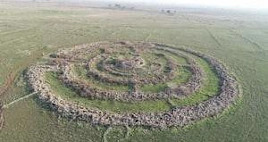

The newly discovered sites all share a similar design: large circular structures, between approximately 50 to 250 meters in diameter, built with stones taken from local basalt fields.
The stone circles of Rujm el-Hiri, nicknamed “Israel’s Stonehenge” or “Gilgal Refaim,” are not the only ones of its kind, according to a new study by Ben-Gurion University of the Negev (BGU) researchers.
By using advanced satellite imagery and remote sensing technology to survey areas previously inaccessible, BGU researchers have identified at least 28 other sites within 25 kilometers of Rujm el-Hiri that were not previously known.
The findings, recently published journal PLOS One, suggest that Rujm el-Hiri was not a singular, isolated monument, but rather an “elaborate example of a widespread architectural tradition integrated into the social and economic systems of the proto-historic Levant.”
Rujm el-Hiri was first discovered in the Golan Heights in 1968, and has been dated to approximately 3,500 and 6,500 years ago. It is made of a central cairn encircled by multiple concentric basalt stone rings, spanning for over 150 meters in diameter.
Satellite imagery revealed that the newly discovered sites share a similar design: large circular structures, between approximately 50 to 250 meters in diameter, built with stones taken from local basalt fieldstones.

Site part of a broader social, economic system
The discovered structures contain circular walls and internal partitions, often located near seasonal water sources and integrated into agricultural land use, revealing how ancient populations managed their resources and moved across the area.
Further, researchers believe the stone circles may have been multi-purpose, serving as ritual gathering places, territorial markers, or assembly sites for ancient herding communities, adding to earlier theories of Rujm el-Hiri being a burial site or astronomical observatory.
According to Dr. Michal Birkenfeld of BGU’s Department of Archaeology, the circles “invite a reinterpretation of significant proto-historic monuments in the region, recognizing them as integral parts of broader social and economic systems.”
"Our analysis may have implications for previous interpretations of Rujm el-Hiri's function," she concluded. "While traditional archaeological methods remain essential, this landscape-based perspective allows us to reach a fuller understanding of these monuments within our shared human past."
LATEST POSTS
- 1
 Figure out How to Improve Your Stream Voyage with Remarkable Trips and Exercises
 - 2Map shows more than 1,900 measles cases across U.S.
- 3Cameroon says Russia has confirmed 16 Cameroonian soldiers died in Ukraine
- 4'Stranger Things' series finale trailer shows Hawkins gang gearing up for last battle with Vecna
- 5The Best 10 Innovation Developments of the Year





- CDC studies show value of nationwide wastewater disease surveillance, as potential funding cut looms
- Famous Restroom Beautifying Styles For 2024
- Monetary Wellness: Planning Tips for Independence from the rat race
- Plane Passenger Allegedly Includes ‘Bomb Threat’ in Hotspot Network Name, Forces Flight to Make Emergency Landing
- Palestinians forced from West Bank refugee camps left in limbo as Israeli demolitions go on
- COGAT discovers motor oil hidden inside UN's humanitarian aid to Gaza in smuggling attempt
- Electric Vehicles for Eco-Accommodating Driving
- Flight cancellations: Full list of 40 airports hit by FAA cuts amid government shutdown
- My prescription costs what?! Pharmacists offer tips that could reduce your out-of-pocket drug costs