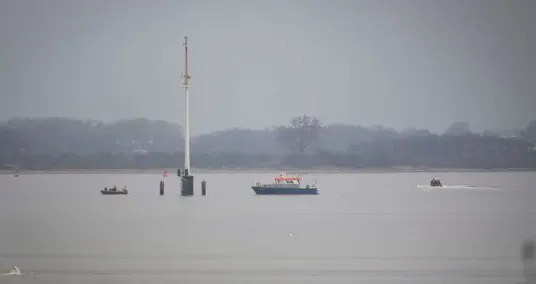
A humpback whale stranded for days off Germany's Baltic coast has freed itself late on Saturday after getting stuck on another sandbank, a spokesman for the Mecklenburg-Western Pomerania Ministry of the Environment said.
The whale was being accompanied by the water police, who are trying to follow it, Claus Tantzen said, adding that, since the waters in the area are very shallow, the animal may get stuck again.
The unlucky animal has garnered massive media attention since it ran aground on a sandbank early on Monday off Germany's Timmendorfer Strand resort, near the city of Lübeck.
Days of efforts to free the 12- to 15-metre whale proved unsuccessful until rescuers dug out a channel in the surrounding sand using a floating excavator on Thursday, allowing the whale to swim free the following night.
However, environmentalists and marine experts had feared that the whale could potentially get stuck again, as it was spotted heading back towards shallower water following its release.
Those concerns became reality on Saturday, with the whale spotted stranded on a sandbank in the Bay of Wismar, some 40 kilometres to the east of Timmendorfer Strand, according to Greenpeace.
Incidentally, it was found beached off the unpopulated island of Walfisch, which translates as whale in English.
"After managing to free itself from its [earlier] predicament, the whale was spotted again at midday today in the Bay of Wismar near the island," the state's Environment Ministry said at the time.
Continued great interest
Following initial sightings on Saturday, a plethora of concerned officials, scientists and activists had headed to the Bay of Wismar in case the creature needed assistance again.
Large whales such as humpback whales are not native to the Baltic Sea but occasionally end up there after following schools of fish in search of food, for example.
According to experts, underwater noise could also play a role in this whale's presence in the Baltic Sea.
Biologists had been hoping the whale would make its way back west towards the North Sea, which would have allowed it to reach the open waters of the Atlantic Ocean.
Following its initial release, conservation groups used dinghies to form a kind of blockade to prevent it from entering shallow water again, trying to guide it further into the deeper waters of the Baltic Sea.
However, the whale was soon spotted further east, off the coast of the Mecklenburg district.
According to the Institute for Terrestrial and Aquatic Wildlife Research, it was impossible to attach a tracking device to the whale because its skin is too diseased.


LATEST POSTS
- 1
 The most effective method to Alter Your Kona SUV for Greatest Solace and Comfort
 - 2Parents who delay baby's first vaccines also likely to skip measles shots
- 3Experts who once backed 'shaken baby' science now fight to free imprisoned caregivers
- 4Step by step instructions to Keep up with Great Hand Cleanliness Before Handshakes
- 5Cuba says 33 have died of mosquito-borne illnesses as epidemic rages


- Journey Travel Objections for Your Next Experience
- Schools to start reopening after Nigeria mass abduction
- Dozens of hidden star streams found in the outskirts of our Milky Way galaxy
- From blowouts to big interiors, ‘Tuscan Mom’ style is Gen Z’s answer to beige burnout
- NASA's Artemis 2 moon launch may be visible from Florida and southern Georgia today. Here's when to look
- 3 back-to-back storms forecast to bring snow and surges of cold air across the Midwest to the Northeast
- Dominating the Mastercard Endorsement Cycle: Six Fundamental Stages
- Explosions heard across Tehran after IDF announces wave of strikes on regime terror targets
- Trial of pro-Palestine activist begins