When you buy through links on our articles, Future and its syndication partners may earn a commission.

Look to the southeastern horizon in the hours following sunset on Nov. 29 — you'll be able to see the moon shine close to the gas giant Saturn as Neptune lurks unseen nearby.
The waxing gibbous moon will appear half-lit on the night of Nov. 29, just one day on from its first quarter phase, as it glows with reflected sunlight beneath the stars of the constellation Pisces. Saturn will appear as a bright "evening star" shining less than 5 degrees — roughly the equivalent to the width of your clenched fist held at arm's length — to the lower right of the gas giant.
Nights surrounding the moon's first quarter phase present a superb opportunity to explore the lunar surface as the line separating night from day — known as the terminator — sweeps across the lunar surface, throwing craters and mountain ranges into sharp relief. As such, the moon will appear particularly spectacular through the eyepiece of a backyard telescope with an aperture of around 6-inches, which will reveal stunning detail in the tortured surface of Earth's ancient companion.
Saturn will make for a striking sight for both naked eye and telescopic observations on the night of Nov. 29. An 8-inch (200 mm) telescope will help reveal the horizontal bands lining the cloud surface of the gas giant, though its iconic ring system is currently positioned almost edge-on to Earth, making it appear as little more than a thin line bisecting the planet through the eyepiece of a scope.

TOP TELESCOPE PICK:

The Celestron NexStar 8SE is a great choice for exploring the cratered surface of Earth's moon and you can currently get it for $200 off during the Black Friday sales! Check out our Black Friday deals page for more!
The night of Nov. 29 will also see Saturn end its "retrograde" westward movement through the stars of Pisces, after which it will begin to track an eastward path through the sky, according to in-the-sky. Planetary retrograde motion occurs in the weeks and months following opposition, when Earth's tighter orbit around the sun causes it to "overtake" more distant worlds, briefly making it appear as if they are moving "backward" in the night sky.
Neptune will also lurk unseen roughly 2 degrees below the moon on the night of Nov. 29, though it will be far too dim to spot with the unaided eye. Under ideal conditions a telescope with an aperture of 8-inches or more may reveal the presence of the planet as a tiny blue dot against the blackness of space. However, the light of the nearby waxing moon could make spotting the distant world more challenging than usual on Nov. 29.
Want to explore the lunar maria and ancient craters of the moon for yourself? Then be sure to check out our roundup of the best telescopes for observing the night sky in 2025.
Editor's Note: If you would like to share your lunar astrophotography with Space.com's readers, then please send your photo(s) and comments, along with your name and location to [email protected].
LATEST POSTS
- 1
 Addressing sleep apnea early might decrease chances of developing Parkinson's disease
 - 2A definitive Cruiser Standoff: Decision in favor of Your #1 Ride
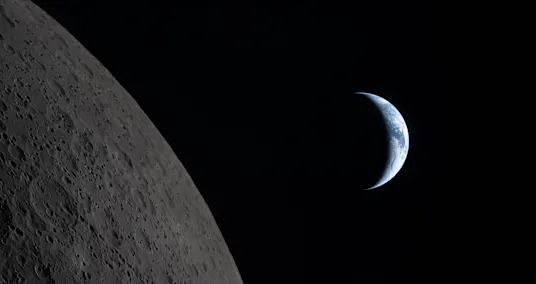
- 3NASA releases stunning new images captured by the Artemis II moon mission, including 'Earthset' and a solar eclipse from space
- 4Carrefour becomes first European retailer to offer shopping on ChatGPT
- 5Most loved Road Food: Which One Prevails upon You?




- Posts falsely claim Netanyahu video fabricated to cover up his death
- Rights group: At least 2,500 deaths during protest crackdown in Iran
- Space debris: will it take a catastrophe for nations to take the issue seriously?
- Venice’s newest marvel is a wild, acrobatic dolphin. His refusal to leave puts him in danger
- Reclassifying Achievement: Individual Accounts of Seeking after Interests
- Which Brilliant Home Gadget Can't You Reside Without?
- Most loved Web-based feature: Which Stage Do You Like
- Viable Correspondence: Building Solid Connections
- 5 High Limit Outer Hard Drives For Information Stockpiling