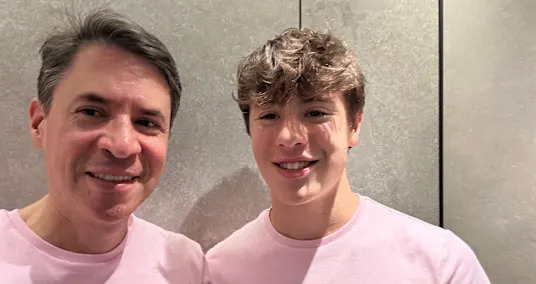
When 51-year-old father of two Juan Uribe shared his first ever TikTok post last month, he did so with a prayer and a plea: Doctors had recently informed him that his 15-year-old son Max, who had a rare blood disorder, would need a stem cell transplant to save his life -- and he would need it soon.
"Hi. My name is Juan, and I'm posting this because I need your help to save my son," Uribe said in the Feb. 10 video.
"My son has a very rare blood disorder that, if it's not treated with a stem cell transplant in the next couple of months, will develop into MDS or AML, which are forms of blood cancer and are very deadly," Uribe continued. "To treat him, he needs a stem cell transplant. If we're able to find a perfect match donor, his five-year survival rate is 95%."

He added, "As a father, I want to do everything I can to make sure that his survival from this and the minimization of complications through the process is as great as possible."
Uribe said it had been "challenging" finding a perfect match donor for his son, because he is half-Colombian.
"I'm 100% Colombian. For minorities, it's very hard to find a perfect match," he explained. "If you're white, you have an 80% chance of finding a match against the global registries. If you're Latino, it's 50%, and if you're Black, it's 30%."
He urged viewers to spread the word to the wider global Latino community, encouraging them to tell friends and family to "get themselves swabbed" to see if they are a match for his son or anyone else.
ABC News' Trevor Ault helps save stranger's life as a stem cell donor
The vulnerable plea struck a chord with social media users. In a matter of 24 hours, more than 11 million people had viewed the video, which now stands at 30.3 million views and counting.
Perhaps more importantly, people from all over the world responded to Uribe's call to action, requesting a swab kit in Max's name.
In a conversation with ABC News, Uribe, who said he left his job last summer to focus on his son, reiterated the urgency of finding a donor, saying, "This is a once in a lifetime opportunity. If we don't get it right now, we can't reverse the consequences. We can't reverse the trauma that we put my son through. So I have to be absolutely focused on this. This is the only thing that matters at this point in time."
10-year-old saves dad's life by donating his stem cells
As many as 75% of patients who need a stem cell transplant do not have a matching donor in their family and must turn to registries like NMDP, formerly the National Marrow Donor Program and Be The Match, for their best chance at a cure, the global nonprofit states.
According to NMDP, human leukocyte antigens, or HLA, are proteins found on most cells in the human body, and your immune system uses HLA to identify which cells belong in your body and which do not.
Doctors use HLA typing to match blood stem cell donors with patients, but it's not as simple as it sounds. The ideal donor is between the age of 18-35, as younger donors offer the best outcomes. Additionally, your body has 12 unique HLA markers, creating millions of possible combinations for doctors to consider when searching for a match.

Out of the nearly 43 million registered donors worldwide, zero perfect matches exist for Max -- not even his twin sister.
"The reason it’s difficult for my son is that my son is a mix of Latino and Caucasian," Uribe said, reiterating his comments from his initial video. "My wife is 100% Caucasian, I'm 100% Colombian. That mix makes the genetic composition in his HLA typing much more rare and more unique. And therefore, in order to find the donor, given the unique combination, we really need to find millions of donors with the hope that we can find one perfect match in that population."
As part of his efforts to help his son, Uribe decided to set a goal to get 1 million new donor registrations in Max's name, in order to give his son the best chance at finding his match.
NMDP partnered with Uribe, who continues to post about his son on social media, to drive people to its website to start the process of learning how to request a swab kit and sign up to be a donor. According to the group, more than 59,000 people have registered to be a stem cell donor through the registry so far.
Despite the odds, Uribe's efforts are making a difference not just for Max, but also for the countless other people who also do not have a match on the registry. With each new person added to the registry, offering to donate their healthy blood, each searching patient has a renewed chance at finding their lifesaving cure.
"I think that there's a real gap and a real need to try and make it as automatic as getting your license or signing up to be a voter," Uribe explained. "[That's] really how widespread we should make getting people added to the stem cell registry.
LATEST POSTS
- 1
 What Yogurt Types Do You Know
 - 2See the first close-up photos of the moon from NASA's Artemis II mission
- 3EU Commission prepares €90bn Ukraine loan despite Hungary's veto
- 4Visual communication Programming for Fledglings
- 5Texas cities have some of the highest preterm birth rates in the US, highlighting maternal health crisis nationwide





- NASA’s Pandora telescope will study stars in detail to learn about the exoplanets orbiting them
- Ukrainian drones hit all three Baltic States − did Russia redirect them?
- Step by step instructions to Guarantee the Life span of Your Dental Inserts: Support and Care Guide
- Israeli lawmakers pass bill reviving death penalty for terrorists
- I’m a dad to an autistic child. Here’s how you can make the holidays easier for all of us.
- The race to mine the moon is on – and it urgently needs some clear international rules
- Photos of amputees in Gaza, struggling to survive after losing limbs to Israeli airstrikes
- Air travelers face higher ticket prices as Iran war drives up oil prices
- Holocaust survivor, descendants urge High Court to allow Gaza children medical access